How to eat a scone
There is no wrong way to eat something you paid for. But there is a two-hundred-year-old argument about the right way, and since we bake scones every morning in the Klang Valley, we have opinions. The short version: split it by hand, spread it warm, and pick a county before anyone asks.
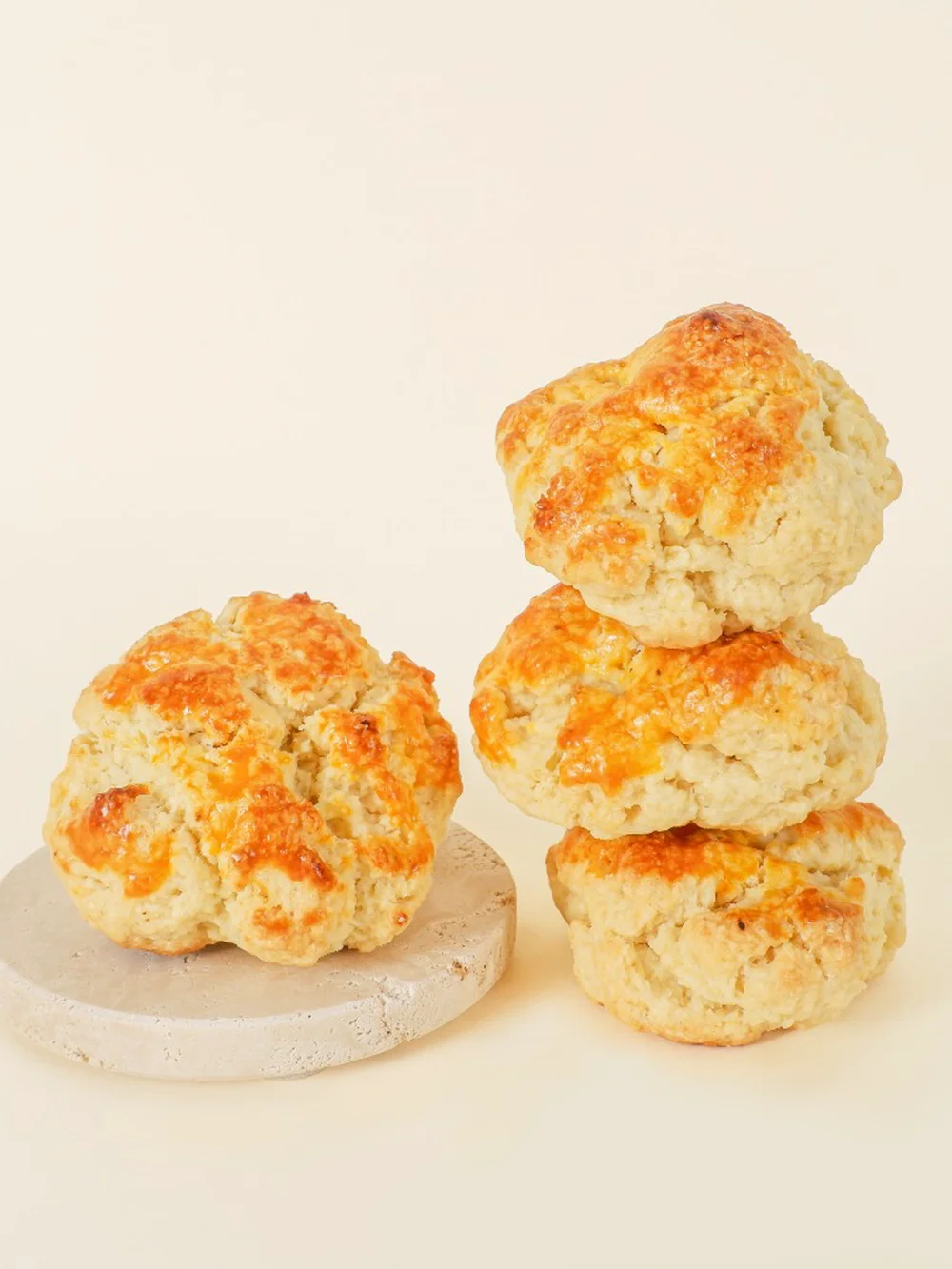
Split it by hand, not with a knife
A scone made in layers wants to come apart in layers. Held at its equator and pulled gently, it breaks along its own middle into two rough halves — which is the whole reason our hero says pull it apart while it's warm. A knife flattens the crumb it cuts through and leaves a surface jam slides off.
Each half is then its own open-faced thing: spread, topped, eaten. Nobody closes a scone back up like a sandwich, for the practical reason that everything on it would come out the sides.
Jam first, or cream first?
This is the oldest argument in the subject and it has two legitimate answers. Devon puts cream on first and jam on top of it, on the logic that the cream is doing butter's job. Cornwall puts jam on first and cream on top, on the logic that you can see how much cream you got.
Having watched a lot of scones eaten: cream-first holds more cream, jam-first is tidier to eat, and the order has never once changed how good the scone underneath was. Warm matters more than either. Pick a county when someone hands you the two jars, and defend it with confidence.
What to spread on one in Malaysia
The full English service is clotted cream and strawberry jam. Clotted cream is findable in Malaysia — the bigger supermarkets carry imported jars in the chilled aisle, at import prices. But if the scones are already on the table and the jar is not, three things stand in for it well, in different directions.
Cold salted butter is the closest in spirit — it melts into a warm scone the same way. Whipping cream, softly whipped and unsweetened, is the closest in texture — though it is not the same thing: clotted cream is made by slowly heating cream until it thickens into something closer to soft butter, half again as rich as anything that pours. Cream cheese with a little honey through it is the richest of the three, and it is not far from what already sits inside our filled flavours.
Strawberry jam is the classic on top for a reason: a plain scone is rich and barely sweet, and the jam brings the acidity it is waiting for. Any jam with some sharpness to it does the same job.
Which of ours want all this, and which want nothing
Original is the one this whole page is about — butter, flour and an overnight rest, baked plain on purpose so there is something to spread on. If you are setting out jam and cream, this is the scone to set them out for.
Cranberry carries its fruit in the dough, so it needs less on top; butter alone is enough. The cream cheese flavours — Earl Grey, Lemon and Matcha — are already filled, and they are built to be eaten warm on the outside with the centre still cold. Adding cream to a scone that already has a cream centre is nobody's idea of restraint, including ours.
What to drink with it
Tea, and the plainer the better — the tannin in black tea cuts through butter and cream, which is the entire architecture of a cream tea. Coffee does the same work if that is your side of that argument. A bergamot tea doubles the Earl Grey scone pleasantly rather than fighting it.
The one thing a scone does not want is a very sweet drink beside it; the pairing works on contrast, and it is the drink's job to bring the edge.
Warm is the whole trick.
Every section above says it because it is true everywhere: a scone is at its best warm, and the surest way to eat one warm is to eat one baked that morning. Everything is pre-order — pick a collection day and we bake to it.
Read next: how to store and reheat scones — keeping times, thawing, and the one flavour most people get wrong.
Or start with one: Scones in Kuala Lumpur, baked to order in Cheras — free collection, or delivery across the Klang Valley.